

The customs, courtesies, and practical logistics that make Japanese golf unlike anywhere else on earth.
Japan is one of the world’s great golf destinations. The courses are well-maintained, the service is attentive, and the experience is organised with a precision you rarely encounter elsewhere. But it is also a destination that rewards preparation. This is a guide for travelling golfers about golf etiquette in Japan and how to respect their traditions when visiting.
Japanese golf culture is built on ritual and respect — for the course, for your fellow players, and for the staff who make the day run. Arriving without an understanding of how a Japanese golf day is structured will leave you constantly catching up. Arriving informed means you can simply enjoy it.
If you are confused, or worried about travelling to Japan with its myriad traditions, Voyages.golf hosts an annual golf tour with expert guides who speak the language and know all the rules. See our escorted tours and find your ultimate Japan Tour.
This guide covers everything: arrival protocol, how the day is sequenced, caddie culture, the buggy system, the mandatory halfway stop, and what to wear — and when. It is written for golfers travelling from Australia, the UK, or anywhere that does not share Japan’s particular approach to the game.

Arrival Protocol: What You Wear to the Club Is Not What You Wear on the Course
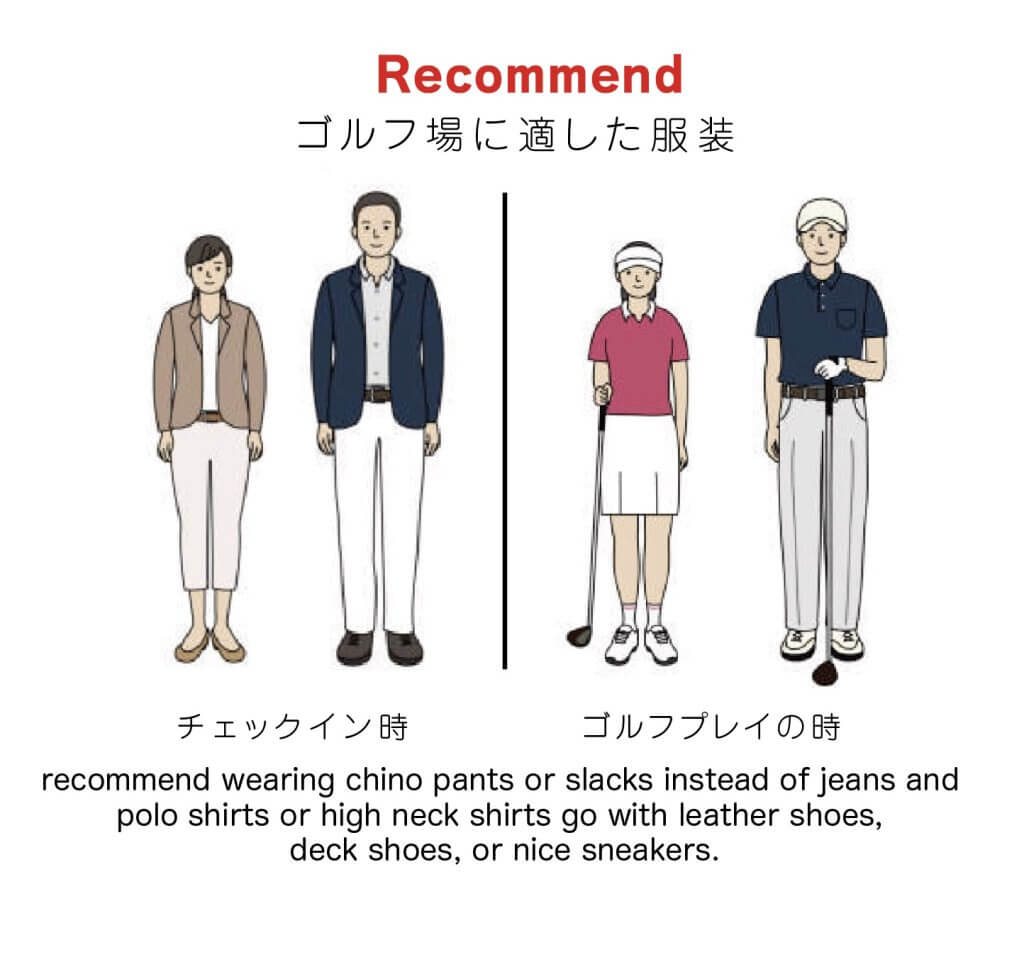
This is one of the most common points of confusion for first-time visitors. In most countries, you arrive at a golf club in your golf clothes and walk straight to the range. In Japan, you do not. You arrive in smart casual attire: clean trousers or chinos, a collared shirt, and closed shoes. Think of it like arriving at a club for dinner, not for a round. Golf shoes, polo shirts, and shorts (where permitted) are changed into in the locker room.
Practical Note:
Upon arrival, a staff member will take your golf bag directly to the bag drop or buggy. You will not carry it through the clubhouse. Your shoes are also separated from the bag and brought through separately. Let the staff manage this — it is part of the system.
You will be issued a locker key, typically a numbered bracelet or card, which you use throughout the day. Keep it on you. It is your identifier across the locker room, the pro shop, the restaurant, and sometimes even the buggy.
At the end of the round, the sequence reverses. You return to the locker room, change out of your golf attire, and head to the dining room or bar — again, in smart casual clothing. Many clubs in Japan have onsen or bath facilities attached to the locker room. Using them is not mandatory, but it is considered part of the post-round wind-down and is well worth the time. Note that use of most onsens means no clothes are allowed, and tattoos should be covered.
The Locker Room
Japanese club locker rooms are typically well-appointed, well-organised, and operate on an understood set of behaviours. A few things to note:
- Golf shoes are left at the locker room entrance or a designated rack, not taken onto the main clubhouse floor unless you’re eating lunch mid-way through your round.
- Towels and toiletries are generally provided. You do not need to bring your own.
- Mobile phone use in the locker room is generally frowned upon. Keep it brief and quiet.
- If there is a bathing area, use it before changing back into street clothes — not after.
Staff members may be present in the locker room to assist. A simple nod and “arigatou gozaimasu” (thank you) goes a long way. You do not need to speak Japanese to be respectful — tone and manner communicate clearly enough.
Caddies: The Heart of the Japanese Golf Experience
At a large proportion of Japanese courses — particularly the private and semi-private clubs — caddies are not optional. They are included as part of the round, and they are central to how the day runs.
A Japanese caddie typically carries two bags and works with a group of two to four players. Their role extends well beyond club selection and distance reading. They manage the buggy, rake bunkers, tend the flag, repair divots, and often guide the group through any course-specific protocols that apply that day.
Caddie etiquette for visiting golfers:
- Accept the caddie’s advice on yardage and course management. They know the course intimately.
- Do not take the bag from the caddie unless specifically discussing club selection. They will handle all carrying and placement.
- Keep your behaviour consistent — quiet, measured, and courteous regardless of how the round is going.
- After the round, tipping is not the cultural norm in Japan. A genuine “arigatou” and a respectful nod is the appropriate acknowledgement. Some tour operators will advise differently based on the club — follow their lead.
- If your caddie speaks limited English, pointing and gesturing works well. Do not speak loudly to compensate for a language gap & always be polite.
Many visiting golfers name their caddie experience as the most memorable part of a Japan golf trip. The level of care and professionalism is consistently high, even at courses that are not in the top tier.
The Buggy System: Remote Controls and Designated Paths
Golf buggies in Japan operate differently to almost anywhere else in the world. At most courses, buggies run on fixed tracks or designated paths and are controlled — in part — by remote control devices operated by the caddies or course staff. Some courses have fully automated buggy systems that follow the group at a set distance.
What this means practically:
- You will not drive the buggy to your ball. The buggy stays on the path, and you walk to your shot.
- Do not attempt to take the buggy off the designated track — it may physically not allow it since buggies follow a magnetic strip on the cart path, or it is simply not permitted.
- Your caddie manages the remote and the buggy movement. Do not interfere with this unless asked.
First time visitor note: The remote-controlled buggy system looks peculiar if you have never seen it. Watching a buggy creep autonomously along a path while a caddie walks ahead is genuinely unusual by Western standards. Once you understand the logic — course protection, pacing, efficiency — it makes complete sense. Lean into it rather than fighting it.
The Mandatory Halfway Stop
This is non-negotiable, and it is worth understanding before you arrive so it does not catch you off guard.
Between the front and back nine, all groups stop at the clubhouse or a dedicated halfway house for a break. This break is typically 30 to 60 minutes. At many clubs, it is scheduled and coordinated: your tee time on the back nine is fixed, and the stop fills the interval.
During the break, a hot meal is served. This is not a snack bar situation: it is a proper sit-down meal. Ramen, udon, rice dishes, tempura: the halfway kitchen at a Japanese golf club is taken seriously. The same applies to green tea, beer, and other drinks, all of which are available. These meals are either included or can be charged to your locker key & paid when you check out.

On-Course Etiquette
Japanese golf culture is quiet, efficient, and deeply courteous. A few specific points that differ from Australian or British norms:
Pace and readiness
Play is expected to move at a consistent pace. Be ready to play when it is your turn. Slow play is taken seriously at Japanese clubs, and groups are expected to maintain position relative to the group ahead. Your caddie will gently manage this — trust the process.
Noise and mobile phones
Conversations on the course are kept to a low register. Mobile phones should be on silent and used minimally during the round. Photography is generally fine, but check with your caddie at any point where signage is posted.
Course care
Divots, bunker raking, and ball mark repair are attended to — by you and your caddie together. If the caddie starts on a repair, assist or stay out of the way. The standard of care Japanese golfers apply to the course is noticeably high.
The practice area
Most clubs have driving ranges and short game areas. Arrive early to use them — they are well maintained and tend to be quieter than ranges in other countries. Warm up properly. Your caddie may join you here to get an early read on your game.
Dress Standards
Japanese golf clubs enforce dress codes with consistency. The specifics vary by club, but the general framework holds:
- Collared shirts are mandatory for men on course. Mock-necks are accepted at some clubs, not all.
- Shorts are permitted at a growing number of clubs but are not universal. Check in advance. If in doubt, wear long trousers.
- Jeans or cargo pants are not appropriate at any point during the day – on course, in the clubhouse, or in the restaurant.
- Soft spikes are standard and expected. Remove them before entering the clubhouse.
Dress-code recommendation – Dress to impress when in doubt.
Pack one smart casual outfit specifically for arrival and departure — not your golf gear. A clean collared shirt, chinos or similar, and clean leather shoes or smart trainers is the appropriate standard. It matters at the better clubs, and you will feel more comfortable for it.
The Locker Key: Your Identifier for the Day
Japan’s golf clubs operate on a centralised account system, tied to your locker key. Almost everything that can be charged to a tab — food, drinks, rental items, the halfway meal, pro shop purchases — is logged against your locker number and settled at the end of the day.
Keep the key on you at all times. It is easy to leave it in the locker and find yourself unable to order lunch. Some clubs use a wristband system; others use a physical key or a card. Whatever form it takes, treat it like your wallet.
At checkout, a printed account is presented — typically in Japanese with some numerals that are universally readable. Staff at reputable clubs will assist visitors in reading the statement. Your tour operator will have arranged any additional charges or inclusions in advance.

A Few Final Points Worth Knowing
- Golf in Japan moves at a set pace.Groups are spaced at regular intervals and the day runs on a schedule. The caddie knows the rhythm — follow them.
- Alcohol is available but not the culture. A beer at the halfway stop is acceptable. Arriving on the back nine visibly affected is not. Read the room.
- Cell service varies. Mountain courses in particular can have limited coverage. Download offline maps or information before you leave the hotel.
- Women’s access has evolved. Historically, some Japanese clubs had strict restrictions on women’s access to certain areas or tee times. This has changed at many clubs, but some traditional private clubs retain limitations. Your tour operator will have navigated this in advance.
- The experience is worth the preparation. Japanese golf is among the best-executed in the world. The courses are exceptional, the service is exceptional, and the entire day — from arrival to post-round meal — is thought through in a way that makes most other countries feel improvised by comparison.