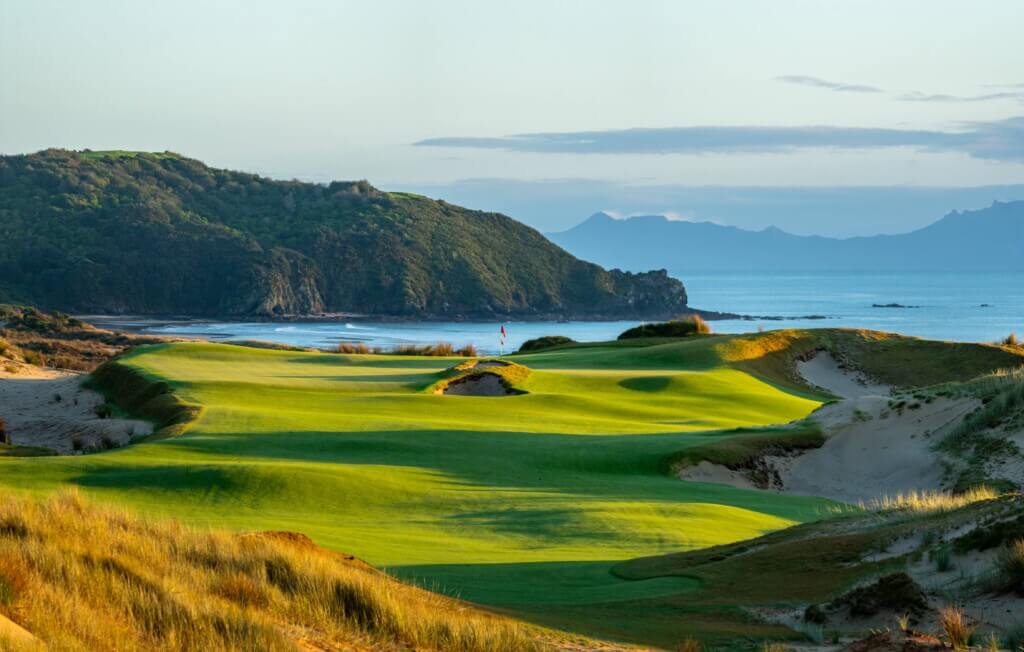
The Ultimate Guide to Playing Golf in New Zealand
Focus: the North Island, with a Queenstown postscript
New Zealand has quietly become one of the most compelling golf destinations on earth, and most of the reason sits on the North Island. In the space of two decades a handful of courses built on clifftops, dune fields and volcanic plateau have gone from unknown to unavoidable in any serious conversation about world golf. The catch is that they are scattered across a country the length of Great Britain, tee-times fill months in advance, and the difference between a good trip and a great one comes down almost entirely to sequencing.
This guide covers what to play, how to get on, what it costs, when to go, and how to string it together.
The short answers
Best time to go: November to March. Late November through early December is the sweet spot — peak course conditioning, daylight past 8.30pm, and ahead of the domestic holiday rush.
How long you need: Ten days minimum for the North Island’s headline courses. Fourteen to do it without rushing.
Where to fly: Auckland is the hub for the North Island. Queenstown for the South.
The single biggest constraint: Tee time, Hotel & Transport access, not cost. Book far earlier than feels necessary.
Why the North Island
The South Island gets the postcards — Queenstown, the Southern Alps, Milford Sound. But the golf concentration is northern.
Of New Zealand’s ten highest-ranked courses in the 2026 national rankings, seven sit on the North Island: Te Arai Links South and North at two and three, Cape Kidnappers at five, Wairakei at six, Paraparaumu Beach at seven and Kinloch at nine, with Kauri Cliffs at ten. Only Jack’s Point at four and The Hills at eight represent the south in the top ten.
More to the point, the northern courses cluster. Te Arai and Kauri Cliffs share a stretch of coast north of Auckland. Wairakei and Kinloch are twenty minutes apart on Lake Taupō. That geography makes a coherent trip possible in a way a nationwide sweep does not.
The North Island courses
Te Arai Links — South and North
The most significant thing to happen to New Zealand golf this century, and now ranked second and third in the country behind only their private neighbour.
The South Course, by Bill Coore and Ben Crenshaw, runs out through native dune country and stands of pōhutukawa before opening to the Pacific. It is wide, strategic and endlessly replayable — the sort of course that rewards a second look far more than a first.
The North Course, by Tom Doak, is the wilder of the pair. Higher dunes, more severity, and a run of ocean holes that stands comparison with anything anywhere.
Access is the thing to understand here. The two courses alternate daily: on any given day one is reserved for members and the other is open to resort guests and green-fee players. You cannot play both in a single day. If you want both — and you should want both — you need at least two days on property, ideally three. Green fees for international visitors run around NZ$650 in high season, with lower domestic rates.
Related: Te Arai Links Stay & Play
Cape Kidnappers — Hawke’s Bay
Tom Doak again, and the course that put New Zealand on the international golf map when it opened in 2004.
Cape Kidnappers is routed along a series of narrow ridges that finger out over the Pacific, some falling away 140 metres to the water on both sides. The sixth, fifteenth and sixteenth are the postcards, but the strength of the course is how the inland holes build tension before releasing you onto the cliffs.
Visitor tee times are available daily, a valid handicap is required, and advance booking is essential. Green fees for international visitors run to roughly NZ$739 in the January-to-March high season, easing considerably in the shoulder and winter months. Resort guests at Rosewood Cape Kidnappers get priority.
Hawke’s Bay is also New Zealand’s premier wine region, which makes it an easy place to build in a rest day.

Kauri Cliffs — Bay of Islands
David Harman’s clifftop layout above Matauri Bay, and the northernmost of the country’s great courses.
Fifteen of the eighteen holes carry ocean views; six are played along cliffs falling to the sea. It is a gentler test than Cape Kidnappers and a more consistently beautiful walk. The par-three seventh, played over a chasm to a green perched above the Pacific, is one of the most photographed holes in the southern hemisphere.
Same access model as Cape Kidnappers — both are Robertson Lodges properties under Rosewood management, with resort guests taking priority and visitor times available by arrangement.
Wairakei Golf + Sanctuary — Taupō
The best inland course in New Zealand, and something genuinely unusual.
Opened in 1970 and comprehensively reimagined since, Wairakei is now enclosed by a predator-proof fence and operates as a working wildlife sanctuary. You will hear and probably see native birds that have vanished from most of the country. The golf is classic parkland — tree-lined, beautifully conditioned, more subtle than dramatic — and it ranks sixth nationally on merit rather than scenery.
The Kinloch Club — Taupō
Jack Nicklaus’s only New Zealand design, twenty minutes from Wairakei on the western shore of Lake Taupō.
Kinloch is inland but plays like links golf — firm turf, rumpled fairways, deep revetted bunkering and constant wind. Nicklaus routed it high above the lake, and the elevation gives you views across the water to the volcanoes of Tongariro on a clear day. Ninth in the country.
Tieke Golf Estate — Waikato
The newest arrival on this list and already inside the national top twenty. A links-inspired layout carved into rolling Waikato farmland outside Cambridge, it fills what used to be an awkward geographic gap between Auckland and Taupō.
Worth your time if you have it
- Paraparaumu Beach (7th) — Alex Russell’s 1949 links north of Wellington, and the historic soul of New Zealand golf. Utterly different from the modern resort courses.
- Titirangi — Alister MacKenzie’s only New Zealand design, in suburban Auckland.
- Royal Wellington — host of the Asia-Pacific Amateur, a superb parkland test.
- Muriwai, Omaha Beach, Mangawhai, Waipu — excellent, affordable, genuinely local golf on the Auckland and Northland coasts. Mangawhai and Waipu both climbed significantly in the 2026 rankings.
- Windross Farm — a modern Auckland course that has hosted the NZ Women’s Open.
Getting on: how access works
This is where most self-planned New Zealand trips come unstuck.
The top courses are resort courses, not public courses. Cape Kidnappers, Kauri Cliffs and Te Arai Links all give priority to guests staying on property. Visitor tee times exist but are limited, released on the resort’s terms, and gone early during the November-to-March season and at far better rates and early booking access.
Book far earlier than feels reasonable. For a peak-season trip, twelve to eighteen months out is normal for the marquee courses. Six months out you are taking what’s left.
Groups are the hardest to place. A fourball can slot into gaps. A group of sixteen cannot. If you are travelling with any number, the tee sheet — not the hotel — is what dictates your itinerary.
When to go
November to March is the season. Courses are at their best and the days are long — sunset past 8.30pm in December.
Late November to early December is arguably the pick. Spring growth has settled, conditions are peak, and you are ahead of the New Zealand summer holidays when domestic demand spikes and rates climb.
January and February are hottest and busiest. Great golf, more competition for tee times.
April and May offer a genuine value window — settled autumn weather, shoulder-season pricing, but shorter days.
June to August is winter. Playable in the north, cheap, but not what you flew this far for.
Whenever you go, pack for four seasons. A still, warm morning can turn into a stiff onshore wind by the fourth hole. And take the sun seriously — New Zealand’s UV index is among the highest in the world.
Getting there and getting around
From Australia: Three to three and a half hours to Auckland from Sydney, Melbourne or Brisbane. The easiest long-haul golf trip an Australian can make.
From the United States: Direct to Auckland from Los Angeles, San Francisco, Houston, Chicago and New York.
From the United Kingdom: No direct service. Route via Los Angeles, San Francisco, Singapore, Dubai, Doha or Hong Kong — reckon on 26 to 30 hours door to door.
On the ground, the North Island golf circuit involves real driving:
- Auckland to Te Arai — about 1 hour 30
- Te Arai to Kauri Cliffs — about 2 hours 30
- Auckland to Taupō — about 3 hours 30
- Taupō to Napier — about 2 hours 30
- Cambridge to Auckland — about 1 hour 30
None of it is difficult. All of it is scenic. But it is left-hand-side driving on two-lane roads, often after eighteen holes, and a group of any size is better served by a coach and driver than by three hire cars and a designated navigator.
Entry requirements and the golf-shoe rule
Australian passport holders need no visa, no NZeTA, and are exempt from the visitor levy.
US and UK passport holders travel visa-free but must obtain an NZeTA before departure, which also triggers the NZ$100 International Visitor Conservation and Tourism Levy. UK passports allow a six-month stay; US passports three months.
Then there is biosecurity, which golfers underestimate. New Zealand’s border controls are among the strictest anywhere, and used outdoor equipment — explicitly including dirty footwear — must be declared on arrival. Failing to declare a biosecurity risk item carries an instant NZ$400 fine.
Practically: scrub your golf shoes before you pack them. Get the soil out of the spikes. Declare them anyway. The officers are entirely reasonable with clean gear and entirely unreasonable with a wedge full of Melbourne sandbelt.
Bringing clubs or hiring
Most travellers bring their own, and on courses this exposed to wind, familiarity is worth something. Every resort course on this list has quality rental sets if you would rather not fight the baggage allowance — Te Arai, Cape Kidnappers and Kauri Cliffs all rent current-model equipment.
Trans-Tasman carriers generally handle golf bags well. Long-haul from Europe or North America, check your allowance before you commit.
Queenstown and the South Island
A postscript rather than a chapter, because the North Island is where the golf density is — but Queenstown is a natural add-on and hard to argue with.
Jack’s Point is ranked fourth in the country and is the picture of Central Otago golf: schist outcrops, tussock, and The Remarkables rising straight out of Lake Wakatipu behind the greens. John Darby’s routing makes the most of a genuinely spectacular site.
Millbrook Resort, near Arrowtown, has 27 holes and co-hosts the New Zealand Open. The Coronet nine, climbing into the tussock beneath Coronet Peak, is the pick of them. It is also the most comfortable base in the region.
The Hills, Sir Michael Hill’s course, sits eighth nationally but is preparing for significant redevelopment — check its status before building a trip around it.
Glendhu Bay, on the shore of Lake Wānaka over the Crown Range, is not a top-ten course and does not pretend to be. It may be the most beautiful setting you will ever play golf in.
Add Arrowtown Golf Club for a charming, affordable round, and Queenstown gives you three or four days of excellent golf wrapped around a town that handles non-golfers better than anywhere else in the country.
Related: Millbrook Golf Resort Stay & Play

If you’re travelling with a non-golfer
New Zealand is unusually good at this, which is not true of every golf destination.
Hawke’s Bay is a serious wine region with Art Deco Napier attached. Taupō has the lake, Huka Falls and geothermal spas at Wairakei Terraces. The Waikato has the Hobbiton Movie Set and the Waitomo glowworm caves. Northland has the Bay of Islands and the Waitangi Treaty Grounds. Queenstown has more to do than any of them.
At almost every stop on the North Island circuit, the non-golfer’s day is at least as good as the golfer’s.
How to structure the trip
Three broad approaches.
The compressed trip (7–8 days). Auckland base, Te Arai for two nights, Kauri Cliffs, and one of Wairakei or Kinloch. You will see the best of it and you will be driving a lot.
The proper circuit (12–14 days). Hawke’s Bay for Cape Kidnappers, north to Taupō for Wairakei and Kinloch, through the Waikato for Tieke and Hobbiton, on to Te Arai for both courses, finishing at Kauri Cliffs in the Bay of Islands. This is the itinerary the geography wants you to follow — it moves in one direction, never backtracks, and gives each region enough time to be worth the drive.
The full sweep (18–21 days). The above plus Queenstown.
The honest difficulty with doing it yourself is not the driving or the planning. It is the tee sheet. Cape Kidnappers, Kauri Cliffs and Te Arai each want to be booked a year out, each has its own access rules, and Te Arai’s alternating-course system means your two rounds there have to be arranged around which course is open on which day. Getting all three to line up in a single trip, in a sensible order, is the whole problem.
Playing it as an escorted tour
For anyone who would rather not spend a year assembling this, an escorted tour solves the sequencing problem outright.
Our New Zealand Golf Tour 2027 runs 23 November to 6 December 2027 and follows the proper-circuit route above: Cape Kidnappers, Wairakei, Kinloch, Tieke, both courses at Te Arai Links, and Kauri Cliffs, with the Hobbiton Behind the Scenes tour, a Craggy Range winery day and a Lake Taupō cruise built into the non-golf days.
Worth noting what that lineup represents: six of New Zealand’s ten highest-ranked courses, and every one in the top ten that a visitor can realistically play, other than Paraparaumu Beach. Add the optional five-night Queenstown extension — Millbrook, Glendhu Bay and Jack’s Point — and it becomes seven of the top ten.
The tour is fully hosted, the group is kept small enough that the tee times hold, and non-golfing partners have their own programme on every golf day.
Related: all escorted golf tours · New Zealand destination guide · enquire about a place
The last word
New Zealand rewards golfers who plan properly and punishes those who improvise. The courses are worth the flight from anywhere — Te Arai and Cape Kidnappers alone justify the trip — but they are not casual walk-ups, and the country is bigger than it looks on a map.
Decide early whether you are going in season, book the marquee courses before you book anything else, and build the rest of the trip around what the tee sheet gives you. Do that and it is one of the great golf journeys available. Leave it late and you will spend a very long flight looking forward to courses you did not get onto.
Sources: 2026 New Zealand Golf Rankings; course access and all information current at the time of writing and subject to change — confirm directly with each club. Entry requirements per Immigration New Zealand; biosecurity requirements per the Ministry for Primary Industries.